The Agitation of the Mind: Despicable Me 2

  • Subscribe to our RSS feed.
  • Twitter
  • StumbleUpon
  • Reddit
  • Facebook
  • Digg
Showing posts with label Winter of Discontent. Show all posts

Saturday, 29 December 2012

WINTER OF DISCONTENT: Hobo with a Shotgun

Posted on 04:44 by Unknown

Come listen to the story of a hobo who turned sour,
Dude got no name but he’s played by Rutger Hauer,
Rode into town on a freight train belchin’ steam*
But life on the streets is where it’s really unclean.

In a town called Hope, where actually there’s none
And the sign’s been repainted so the name’s now Scum,
Our hobo hero dude who ain’t go no name
Goes beggin’ on the sidewalk for a handful of change.

Ragged and dirty, ignored and overlooked,
All our guy wants to do is scrape up fifty bucks
To a buy a lawnmower from a pawn shop downtown,
Do yard work for cash, try to turn his life around.

But the seedy town of Scum (used to be called Hope)
Is ruled with fear by this crazy psycho bloke
Who wears a white suit though his deeds are deadly dark
And his psycho sons who are chips off the block.**

Then our hero meets a girl – a blameless innocent
(Or so he believes; she turns tricks to pay the rent).
When white suit psycho’s son starts jonesing for her bad
Cue hobo as a shotgun-wielding surrogate dad.

In a town that’s lawless, that’s morally destitute,
Where a paedophile cruises dressed in Santa suit,
Where the cops are corrupt and robberies are rife,
Death is dirt cheap but the cheapest thing is life.

In a place where the only career choice is crime,
Our hero cleans up the town, one deadbeat at a time,
Each pitiful pederast, each misogynistic male,
A join-the-dots corpse-strewn spent cartridge trail.

It’s a crusade that puts white suit and sonny-boy on edge;
Their empire crumbling, they call in The Pledge.
At this point a movie that’s already kind of mental
Buys a first class ticket to What The Fuck Central.

The Pledge are two bikers full-on dressed in armour,
Either they’re inhuman or they personify karma;
They’ve bumped off bishops and slaughtered men of state,
They keep a kraken in the cellar, a pet they love to bait.

‘Hobo with a Shotgun’ is one weird fucked-up flick:
Half of it is funny and the other half’s plain sick.
Viewed through alcoholic fug or substances proscribed
It’s an out-and-out cult classic, a trash fan’s wild ride.

But watch the thing cold sober and, buddy, you will find
It will (to quote Cartman) warp your fragile little mind;
It’ll leave your brain scrambled and your senses desiccated
And maroon you at a certain blog whose content’s agitated.


*All right, it’s a diesel. But I’m writing this mo’ fo’ in verse so I claim poetic licence. 

**Epic fail on the rhyming in this stanza.
Read More
Posted in Rutger Hauer, Winter of Discontent | No comments

Thursday, 27 December 2012

WINTER OF DISCONTENT: Lifeforce

Posted on 08:51 by Unknown

It was a few months ago that I watched ‘Lifeforce’, already with a mind to writing it up for the Winter of Discontent. Reviewing my notes, I realise there’s no other way of engaging with the movie than to present, unedited and without contextualizing footnotes, the 500 words of appalled scribbling I produced during the two hours of this holy-fucking-awful excuse for a moving picture:

Five minutes in; first question: when Henry Mancini wrote the score, did he get really fucked up on peyote and hallucinate that he was Hindemith?

Okay, I can live with the shuttle being called the HMS Churchill, but does the alien planet have to look like a giant vulva?

So ... the alien planet: bats, a Nosferatu-like claw and naked chicks in crystal pods. And this was written by the same dude who scripted 'Alien'? Fuck my life!

“I’ve been in space for six months and she looks perfect to me.” No disrespect, bro, but a Tiffany album cover probably would after six months in zero g.

“Stand by for soft-dock.” Somehow I doubt this is a real astronautical term.


Somebody actually said: “Houston, we have a problem.” Please tell me this wasn’t scripted. Please tell me the actor was just taking the piss and it somehow made the final cut.

Interplanetary spaceflight is the norm and the ship’s log is recorded on BETAMAX???

“We were just talking about how to get it open and it popped open of its own accord.” They PAID someone to write this???

Mrs F has just called me “a pervert” for watching this film. It’s very difficult to mount a defence. 

The nudity-to-tedious-exposition ratio is so far swinging heavily in favour of tedious exposition.

Oooh, interesting. Naked alien DUDES. Being shot in phallocentric fashion by army guys. I do believe we’ve rendezvoused with a homoerotic subtext.

OMG! That is THE worst reanimated corpse in the history of cinema.


The hot-alien-brunette nudity to dead-leathery-person nudity ratio is also considerably out of whack.

For an exploitation movie based on the precept “hot naked alien chick wreaks havoc”, ‘Lifeforce’ sure as hell has some boring passages.

“How exactly did he die, Colonel?” “The life just drained out of him.” Yeah, same for the audience.

Jess Franco should have directed this. ‘Lifeforce’ is ‘Female Vampire’ is space, with Mathilda May standing in for Lina Romay.


Telepathy … Volvos … oh dear God in Heaven, Patrick Stewart’s in this POS. I am beginning to doubt my sanity.

Patrick Stewart is screaming fit to wake the dead. He must have got a look at the script.

In terms of production values, this can best be described as ‘Blake’s 7’ with boobs. Not that there have been any boobs for the last half hour. Tobe Hooper, you frickin’ owe me!

“Sterilization by thermonuclear device has been approved.” Whoa! Wait a minute! I work in healthcare and that goes waaaaayyy beyond sterilization. Like seriously, dudes.

15 minutes to go, London’s in the grip of a vampire/zombie invasion, the promised nudity has disappeared, and the level of cinematic craftsmanship on display is making your average Bruno Mattei quickie look like un film de Carl Dreyer.

Swords … bat creatures … columns of blue light. I just don’t have the words …


Peter Firth prevents Steve Railsback from getting it on with Mathilda May and THAT’S a happy ending? I must have missed something.
Read More
Posted in Mathilda May, Patrick Stewart, Steve Railsback, Tobe Hooper, Winter of Discontent | No comments

Sunday, 23 December 2012

WINTER OF DISCONTENT: Late Night Trains

Posted on 14:48 by Unknown

I’d been told that Aldo Lado’s ‘Late Night Trains’ was a pretty damn nasty movie. I’d been told it was ugly, brutal, squalid and cynical. That it was cold, hard and unflinching. That it made for uneasy viewing. That I’d come away from it feeling battered and soiled. And I’m glad I was given those warnings. But I didn’t realize how truly sickening its most horrible, most repulsive moment would be: four entire minutes in which my sense of aesthetics was viciously and incessantly abused. I refer, of course, to the opening credits sequence which plays out to Demis Roussos singing ‘A Flower is All You Need’.

It’s one thing making a rape/revenge exploitation which lifts set-pieces and plot points wholesale from ‘Last House on the Left’ (which itself happily rips off Ingmar Bergman’s ‘The Virgin Spring’); it’s quite another to assault the viewer with the tonsil-quivering falsetto of Demis fuckin’ Roussos. I call everyone involved a sick bastard of the highest order.

Of course, it’s easy to see what Lado’s up to in his use of ‘A Flower is All You Need’. It provides, at first, a mawkish accompaniment to scenes of shoppers making their purchases at a German Christmas market. And not a chintzy false one like we have in Nottingham every year. This is the real deal, since the film opens in Germany. During this montage we catch our first glimpse of our soon-to-be-very-beleaguered heroines Margaret (Irene Miracle) and Lisa (Laura D’Angelo), as well as a rather aloof middle-class blonde woman, who gets no appellation, in the film itself or the end credits, beyond The Lady on the Train (Macha Meril). We also get introduced to Blackie (Flavio Bucci) – so called for the colour of his hair – and Curly (Gianfranco Di Grassi) – also monikered for follicle-inspired reasons – who, it is swiftly revealed, are a pair of unlikeable thugs. Their first act? Beating up a stallholder dressed as Santa for a few lousy coins. Their second? Taking a knife to a rich woman’s fur coat. It’s at this point that Demis fuckin’ Rossous’s wailings cease being mawkish accompaniment and instead get pressganged into ironic counterpoint duties.


It’s from the fur-coated slicing incident that Blackie and Curly, pursued by the authorities, flee into a station and jump on a train just as it’s pulling out. The same train, as if none of us saw this one coming, that Margaret and Lisa are travelling on. They’re going to Verona to spend Christmas with Lisa’s well-to-do father, Professor Guilio Stradi (Enrico Maria Salerno), a consultant at a metropolitan hospital), and step-mother Laura (Marina Berti). Once onboard, Blackie encounters The Lady on the Train (hereafter TLotT), promptly sexually assaulting her. She responds to the rough treatment and is soon manipulating Blackie and Curly as they menace and inevitably assault the two girls.

Actually, scratch that; the word “soon” has no business in that last sentence. ‘Late Night Trains’ boasts the slowest first half in the history of exploitation cinema. There are endless vignettes sketching in the other passengers on the train – including a delegation from the Catholic church, and a compartment full of ex-Nazis – the end result being that the train is so overcrowded that Lado and his four screenwriters contrive to have Margaret and Lisa, Blackie and Curly, and TLotT change trains (this second one, by contrast, is almost deserted) just so the nasty stuff can take place without interruption. Also during these long, narratively encumbered 40 minutes or so, we’re treated to one of the least realistic operations ever performed on film (it basically consists of Stradi slicing into a piece of foam rubber while saying, more or less, “Scalpel … swab … keep swabbing … okay, we done”); Stradi talking about society’s problems during a hoity-toity dinner party and identifying himself as a peace-loving liberal; and Margaret and Lisa endlessly giggling about boys, the former having done the deed with a spotty fellow student while Lisa remains uninitiated into the global cult of snu-snu.

These moments are so unsubtle that Lado might as well have got the writers to stand in background holding up placards reading “HE’S A DOCTOR, THAT MEANS HE’S SWORN TO PROTECT LIFE, BUT LET’S SEE HOW LONG THAT LASTS WHEN HIS DAUGHTER GETS VIOLATED AND KILLED … IRONY, HUH?” and “SHE’S A VIRGIN. LIKE ‘THE VIRGIN SPRING’. DO YOU SEE WHAT WE DID THERE?” On the subject of the multiplicity of contributors to the screenplay, I’m not sure what depresses me the most – the fact that it took four people to rip off ‘Last House on the Left’, or that anyone wanted to rip off ‘Last House on the Left’ in the first place.


Lado ups the ante during the protracted middle section, though. The manipulation of lower class Blackie and Curly (muscle; no brains) by middle-class TLotT (elegant, seductive; amoral) contrasts effectively with the opulent but empty Christmas celebrations hosted by Stradi and his trophy girlfriend (tellingly, Guilio and Laura are on the precipice of a relationship-destroying argument when their guests arrive and things settle back into a brittle status quo). There’s a conceptually horrible and utterly unexpected payoff to the Blackie and Curly/Margaret and Lisa dynamic, and Lado conjures a shot of a corpse being hurled off a railway bridge that somehow achieves a weird visual poetry.

So: from dull as ditchwater to brutally effective … only for things to go south in the finale. This, folks, is the section in which the scripters might as well have turned up with another placard, this one reading “È L’ULTIMA CASA A SINISTRA … MA CON UN TRENO DEL CAZZO, VA BENE?” For this is, indeed, ‘The Last House on the Left’ … but with a fucking train, all right?

Trundling as I am towards the 1,000 word mark, I won’t belabour the suspension-of-disbelief-severing circumstances that land the killers at chez Stradi, or the unrealistic means by which relatives receive the bad news (because, yeah, you’d hear the victim’s name on the radio before the police had even commenced an investigation), or the utterly pointless scene, on Christmas morning, where a witness makes an anonymous tip off from a petrol station at which a truck driver is filling up. (Where the fuck is a truck driver delivering to on Christmas morning? Does Santa subcontract on the continent?) Suffice it to say that the last twenty minutes steer unambiguously into distraught-(formerly-peace-loving)-relatives-go-apeshit territory.


It’s to the detriment of ‘Late Night Trains’ that Lado and co. draw so slavishly on ‘Last House on the Left’. With its attempt at a genuine social commentary (class differences and exploitation), and its unsubtle but effective shifts between the girls’ ordeal on the train and the facile artifice of Christmas at the Stradis’, Lado’s film is certainly a more effective outing than Craven’s notorious-but-actually-not-very-good shocker. Wasn’t it Stephen King who described the film as “Abbott and Costello meet the rapists”? ‘Late Night Trains’ wants to be a much better film, wants to instigate social, political and ideological debate. But it homages, evokes and outright copies an inferior piece of work in frame after frame to the point where you wish it had simply done its own thing with the material.

‘Late Night Trains’, frustratingly, could have been so much more. More focused, more intelligent, more provocative. Nastier.
Read More
Posted in Aldo Lado, Enrico Maria Salerno, Flavio Bucci, Gianfranco Di Grassi, Irene Miracle, Laura D'Angelo, Macha Meril, Martina Berti, Winter of Discontent | No comments

Friday, 21 December 2012

WINTER OF DISCONTENT: Inglorious Bastards

Posted on 15:14 by Unknown

It was probably just as well for Quentin Tarantino that some enterprising distributor decided that Enzo G. Castellari’s ‘Quel Maledetto Treno Blindato’ would clean up in the English-speaking territories if it was retitled ‘Inglorious Bastards’. Somehow, Tarantino’s epic wouldn’t have benefited from borrowing the title ‘That Damned Armoured Train’. For a start, there’s no train in the Tarantino film.

There’s most definitely a train in Castellari’s warsploitation opus. And it’s most definitely armoured. Damned? Given the amount of people who are shot, stabbed or blown up on or around it, that’s pretty much a definite as well. There’s no accusing ‘Quel Maledetto Treno Blindato’ of not delivering on its title.

Although it was made eleven years after ‘The Dirty Dozen’ – a rare example of an Italian exploitation director taking his sweet time in jumping on a bandwagon – Robert Aldrich’s cynical classic is unequivocally the primary source of inspiration in a film that also happily pilfers from John Frankenheimer’s ‘The Train’, John Sturges’s ‘The Great Escape’ and, uh, Umberto Lenzi’s ‘Battle of the Commandos’.


If ‘The Dirty Dozen’ is basically bunch-of-crims-cajoled-into-a-suicide-mission, then ‘Inglorious Bastards’ (I’ll stick with the English title for purposes of this review, though I much prefer ‘Quel Maledetto Treno Blindato’) is bunch-of-deserters-compromised-into-accepted-suicide-mission. How they become compromised, with only a moderate spoiler along the way, is like this:

It’s 1944 in the Ardennes and a truck containing a dozen or so military prisoners leaves an American base under the command of a prissy sergeant played by John Loffredo who’s not important enough to have a name. He’s got a moustache that’s trimmed to within an inch of its life and a side parting you could use as a slide-rule, so let’s call him Sgt Wellgroomed. The truck sets off but a blow-out strands them out in the open and easy pickings for a passing German fighter plane. Sgt Wellgroomed and his fellow guards pile out and take cover, ordering the prisoners to remain in the truck. Some are killed when the fighter strafes them, others when they pile out of the truck and Sgt Wellgroomed opens fire on them. Once the attack is over and a righteously indignant Private Fred Canfield (Fred Williamson) has throttled Sgt Wellgroomed, the numbers have been reduced to five: the aforementioned Canfield, Lt Robert Yeager (Bo Svenson), and three others who, to the best of my recollection, are only outfitted with forenames: wisecracking asshole Tony (Peter Hooten), thief and forger Nick (Michael Pergolani) and the youthful and perpetually terrified Berle (Jackie Basehart). Together, under the nominal leadership of Yaeger, they decide to take their chances crossing Nazi-occupied territory in the direction of the Swiss border. Meeting up with a fellow deserter – if from the opposite side – Adolf Sachs (Raimund Harmstorf), he briefly becomes part of their merry band even if Tony doesn’t trust him. Mind you, Tony doesn’t much like Fred either on account of him being black. So really Tony’s an asshole is what it all comes down to. Anyway, with Adolf tagging along they have various adventures and narrow escapes until a misunderstanding of brobdingnagian proportions results in a firefight with a group of American commandos disguised as Germans en route to a rendezvous with their French Resistance contacts. Net result: dead commandos, extremely pissed off commanding officer Colonel Tom Buckner (Ian Bannen), and a Resistance cell still in need of assistance to accomplish one of those archetypal could-change-the-course-of-the-war missions.

Said mission involves a train. An armoured one.


Which is where we came in. 

Enzo G. Castellari is one of the minor poets of trash cinema (his second division giallo ‘Cold Eyes of Fear’ has already been part of the Winter of Discontent); by the time he directed ‘Inglorious Bastards’, had chalked up spaghetti western classic ‘Keoma: The Violent Breed’ (another title that’s more than justified by the content) and the cracking crime thriller ‘The Heroin Busters’. Later, he’d helm the ‘Bronx Warriors’ trilogy, a mash-up of John Carpenter’s ‘Escape from New York’ and the expected tropes of the post-apocalypse subgenre that became its own epic saga. Castellari knows what makes genre cinema work: pace, story and incident. Plenty of it. 

Barely ten minutes goes by without an explosion, an exchange of gunfire or a hair’s breadth escape. Exposition is slotted in as and when. There’s a hint of character dynamics, but not so much that it would slow things down. Castellari keeps the pedal to the metal – or, this being a movie prominently featuring a train, the firebox stoked and the regulator wide open – and gives the B-movie audience what they want: dangerous guys armed to the teeth cutting a swathe through the Hun, a perilous mission with no guarantee of survival and a token scene of nudity just so no-one can complain that the flick didn’t tick all of the boxes.


‘Inglorious Bastards’ gives us a terrific action movie cast (seriously, when Bo Svenson and Fred Williamson get tooled up you just know it’s know it’s going to be spent cartridges a-go-go) with the unexpected inclusion of Bannen giving things a bit of class. But only a bit, mind. ‘Inglorious Bastards’ doesn’t want to be an actor’s movie; it just wants to entertain you. And it certainly fulfils its remit. You’ll cheer through your beer and popcorn when that model railway blows up at the end.
Read More
Posted in Bo Svenson, Enzo G Castellari, Fred Williamson, Ian Bannen, Winter of Discontent | No comments

Wednesday, 19 December 2012

WINTER OF DISCONTENT: Cold Eyes of Fear

Posted on 13:58 by Unknown

The phrase “London-set giallo” conjures some classics of the genre. Sergio Martino’s ‘All the Colours of the Dark’, Lucio Fulci’s ‘A Lizard in a Woman’s Skin’ and Massimo Dallamano’s ‘What Have You Done to Solange?’ spring immediately to mind, not to mention the latter half of Luciano Ercoli’s ‘Death Walks in High Heels’.

Enzo G. Castellari’s ‘Cold Eyes of Fear’ is set in London. And it’s kind of a giallo. That’s about all.

The opening credits sequence has a car driving through a foggy London during the evening. There is scant regard for geography, but I’m not holding that against the film. ‘A Lizard in a Woman’s Skin’ is a bona fide giallo classic and it has the Old Bailey across on the opposite side of the road to the Royal Albert Hall, so fuck the map.

We then immediately leap into obvious genre territory as a sexy blonde (Karin Schubert) is menaced by a man wielding a knife. Castellari spins the scene out for all its worth, and the sexualized threat of violence is about as politically incorrect as it gets. Cue the rug pull: this is just a performance piece in a sleazy club.


In the audience: Peter Flower (Gianni Garko), a solicitor with a taste for the lowbrow, and Anna (Giovanna Ralli), the original good-time girl had by all. They click, this mismatched pair, and Peter decides to “borrow” his uncle’s palatial house for the evening. The uncle (Fernando Rey) – a high court judge trying a big case, won’t be home till the early hours and a phone call is all it takes to persuade his butler Hawkins (Leonardo Scavino) to absent himself for the night. Only things don’t go according to plan and instead of getting his end away, Peter finds himself at the less than tender mercies of sexually ambiguous thug Quill (Julian Mateos). Then Arthur (Frank Wolff) joins the party and ulterior motives come to the surface.

‘Cold Eyes of Fear’ quickly segues from giallo to home invasion exploitationer, and gradually to political thriller. A third act debate on corruption in high places, the inviolate status of the upper classes and their manipulation of less privileged members of the social hierarchy takes things into interesting territory, albeit with a heavy reliance on cack-handed surrealism.

Castellari keeps things tense, directing with enough energy to distract from the script’s inherent staginess (with the exception of only a handful of exteriors, things delineate between the house and Peter’s uncle’s office). Exposition is trickled out sparingly and for much of the running time there’s a genuine mystery about Quill and Arthur’s objectives. The dynamics between hostages and villains shift in a variety of ways, with Anna proving the wild card. The Arthur/Peter antagonism is slow burn.


Where things fall down is in the filmmakers’ absolute rejection of continuity. ‘Cold Eyes of Fear’ plays out over a single night; the exact timeframe is ambiguous but I reckoned it as roughly early evening till about midnight. Shots vary between twilight, full dark and broad daylight, with weather conditions alternating between a pea-souper fog and cloudless night sky. Lighting levels in the house vacillate from soft and diffuse to harshly lit. A scene where a blown fuse renders everything pitch black, characters stumbling around and disoriented, forgets that there’s a blazing log fire and moonlight streaming through the windows. Moreover, various arrivals at the house necessitate the ornate wrought-iron gates at the end of the driveway repeatedly opening and closing themselves during the course of the night.

Continuity flubs happen in even the best produced movies (‘Goodfellas’ has more than its fair share) and often slip by unnoticed. In ‘Cold Eyes of Fear’, errors dance a conga-line across the screen, announcing themselves shamelessly. Already flawed, the movie doesn’t have any favours done for it by the Redemption DVD print that I watched; it looks like someone recorded it off the TV on a camera phone, while the soundtrack crackles and hisses like an old gramophone record.


Still, clocking in at less than an hour and a half, it doesn’t overstay its welcome; Castellari achieves a real sense of the unexpected as the narrative twists and turns its way towards the denouement; and Rey and Wolff – who died in his early forties just a couple of years after making this film – provide a welcome degree of gravitas.

London-set: yes. Giallo: partially. Exploitation status: minor league. ’Nuff said.
Read More
Posted in Enzo G Castellari, Fernando Rey, Frank Wolff, Gianni Garko, Giovanna Ralli, Karin Schubert, Winter of Discontent | No comments

Monday, 17 December 2012

WINTER OF DISCONTENT: Les Demoniaques

Posted on 09:47 by Unknown
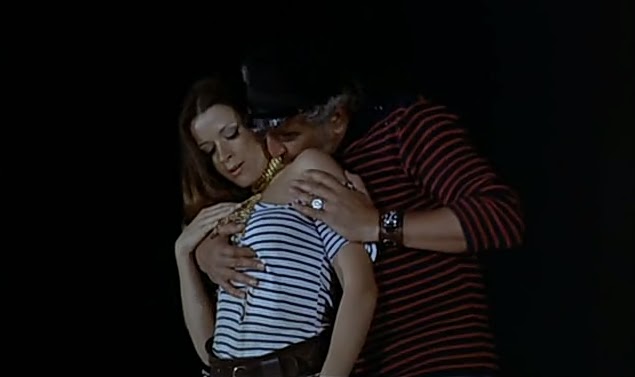
Against a backdrop of flames brightening a shoreline by night, their faces superimposed as if in oval picture frames, Jean Rollin introduces us to the dramatis personae of ‘Les Demoniaques’. It would be appallingly cutesy if the flames weren’t the burning wreck of a ship and the characters in question a villainous bunch of wreckers. Meet the Captain (John Rico):


And meet the Captain’s lady, Tina (Joelle Coeur) – although “lady” might be pushing it a bit:


Rounding out this crude and cruel crew are Bosco (Willy Braque) and Paul (Paul Bisciglia). Voiceover sketches in a power struggle between the Captain and Bosco while casting aspersions on Paul’s loyalty. Quite to what purpose I have no idea, since none of this is ever revisited.

The story – I’m using the word loosely since, as ever in the Rollin filmography, narrative counts for sweet f.a. – starts on that same dark shoreline as the wreckers haul some washed-up chests onto the beach and go through their contents. There’s no glimpse of a sinking ship, but then again budgets aren’t a staple of Rollin’s work either. Everything’s going swimmingly (drowningly?) and the Captain’s trading off some jewelry for sexual favours from Tina …


… when the night is pierced by cries for help, and out of the sea come two orphan girls. Anyone with Jean Rollin scorecard in front of them can tick off “beach” and “two orphan girls” immediately and get their pen ready for “gratuitous nudity” and “ridiculously protracted sex scene” in just a minute. Anyway, these two waifs (they’re not named, spend the virtually the whole film mute, and it’s chiefly thanks to IMDb that I can identify them as being played by Lieva Lone and Patricia Hermenier) don’t get any help from the wreckers whatsoever. Quite the contrary. They’re raped and left for dead, an ordeal that get’s Tina so hot under the collar that she peels off her duds, dances naked on a promontory and has awkward looking sex with the Captain on a rock.


This venal business occupies almost twenty minutes. Then we cut to a tavern at which El Captaino and his less-than-merry bunch are drinking, carousing with saloon girls, and generally blowing their ill-gotten gains. Louise (Louise Dhour), the madame of this establishment, baits the Captain with knowledge of his activities. He denies being a wrecker, but starts experiencing hallucinations of the dead girls.


Louise has the gift of second sight and intuits that something preternatural is going to happen. Eventually – and I do mean eventually: the tavern sequence drags on almost as long as the first scene – a terrified local runs in and announces that the dead are walking the streets. Guessing that what he’s seen is the pale and injured orphans who weren’t quite as left-for-dead as they thought, the wreckers set out to hunt them down and finish the job.

After a tense bit of cat and mouse amongst the wrecks of old ships that line the beach (easily the film’s best sequence, Rollin’s camera painting with shadows), the girls escape to some ruins on the outskirts of town which are said to be haunted; the reputation is enough to dissuade the Captain from pursuing, even though Tina, crazed with bloodlust, is well up for tackling the girls on her own.

We’re at the halfway mark now and ‘Les Demoniaques’ is about to go full-tilt into WTF territory. Still got that Jean Rollin scorecard handy? We’re about to tick off “ruined abbey”, “dark ritual (involving nudity)” and “outright surrealism”. The girls arrive at the ruins where they’re met by a strange woman dressed as a clown (Mireille Dargent) …


… who seems to live at the abbey with a guy who dresses a priest (albeit a somewhat new age-y one) and another guy who’s locked in a cell (the ruins are barely standing, but hey there’s perfectly secure cell) and can only be freed, apparently, by someone coming to him of their own accord. It seems to help if said someone is female. And naked. IMDb pegs these gentlemen as, respectively, the exorcist (Ben Zimet) and the devil (Miletic Zivomir). Specious descriptions at best.

The girls, seeking vengeance, agree to a ritual in which the devil transfers his powers to them. This involves having sex among the ruins …


… and only lasts till dawn. The powers, that is, not the sex. Although the devil probably has the stamina for it. Anyway, the girls make a right hash of their revenge and as dawn approaches the wreckers, unaware that they are soon to meet their own fate, have one last but extremely nasty surprise left in store for them.

As the 800 odd words above indicate, ‘Les Demoniaques’ has more of a plot than your average Rollin film, and the imagery (for the most part) works in the service of said plot. As opposed to many other Rollin films where ethereal women – often vampires, mostly naked – wander round old houses and other women (unclothed, natch) pop out of grandfather clocks and there’s generally no reason for any of it beyond (a) it looks cool and (b) it pads out the running time. Not that ‘Les Demoniaques’ doesn’t have its longueurs, certainly in the first half.

Nonetheless, this lip service to storytelling makes this one of the most entertaining of Rollin’s output, despite the grim commitment to being resolutely downbeat that characterizes the last twenty minutes or so. As ever, atmosphere is everything and there are some genuinely haunting moments. Also as is Rollin’s wont, these moments sit cheek-by-jowl with rampant what-the-fuckery. And that’s what makes his work infinitely watchable. That and the naked ladies.
Read More
Posted in Jean Rollin, Joelle Coeur, John Rico, Lieva Lone, Mireille Dargent, Patricia Hermenier, Winter of Discontent | No comments

Thursday, 13 December 2012

WINTER OF DISCONTENT: Red State

Posted on 12:53 by Unknown

In which Kevin Smith pulls the rug out from under his audience’s feet. And then the floorboards. And then the foundations. And then what you were kind of hoping was some semblance of solid ground. ‘Red State’, in short, is a film that sets out to fuck with you.

It fucks with you via its title and the way it’s advertised. ‘Red State’. The DVD cover art shows an attractive young woman clutching a fuck-off big semi-automatic rifle. Hmmmm, political thriller, you might well think. Patty Hearst type shenanigans, mayhap. Something of a change of pace for Smith.

Then you slide the DVD in and the film gets ready for its first rug-pull.

We’re in small town America and three high-school losers are looking to get laid via the internet. Our testosterone-addled triumvirate – Jarod (Kyle Gallner), Travis (Michael Angarano) and Billy-Ray (Nicholas Braun) – have hooked up with trailer park milf Sara (Melissa Leo), but when they fetch up at her trailer it’s not the older woman fantasy made flesh that they get but a mickey finn in their beer and they wake up bound and caged and at the mercy of bigoted preacher Abin Cooper (Michael Parks). Cooper has some very intractable ideas about sin and how to deal with sinners. Shooting them in the head seems to be a favourite. And he really has a beef about sins involving carnality.


Hmmmmm, you think, torture porn mise en scene ahoy. What we have here is a horror movie that takes some satirical broadsides at fundamentalist Christianity.

At which point another rug pull occurs as ATF agent Joseph Keenan (John Goodman) and his right hand man ASAC Brooks (Kevin Pollak) enter the picture. Keenan’s politically motivated boss has given the order, following an altercation with local law enforcement officers at Cooper’s compound that leaves a deputy dead, to go in with all guns blazing. And just in case there’s any negative publicity or hesitation over the order, Keenan and his men are instructed to regard Cooper and co. not as First Amendment protected citizens practising their right to freedom of religion but as a dangerous terrorist cell every man jack of whom should be shot on site. And by “every man jack”, that means the women and children who are also gathered at the compound.


Right, got it, you say to yourself. Took a while, but what Smith’s doing here is laying down an early John Carpenter siege movie vibe, making a scathing comment about America’s obsession with gun culture and getting into a debate on post-9/11 political heavy-handedness. You might also, at this point, resign yourself to the fact that Jay and Silent Bob aren’t going to be showing up in this one.

Then … well, whaddaya fuckin’ know … there’s another dang rug-pull. And all of a sudden we’re into some very weird territory. How weird? Imagine the conceptual ending of ‘Breaking the Waves’ spliced into a John Woo stylee shoot-out. Or ‘The Rapture’ if Sam Peckinpah had got hold of the script and decided that what all this metaphysical god-boy stuff needed to kick it up a notch was plenty of spent cartridges.


This particular rug-pull happens a smidgin before the hour mark; and for all that the end credits start rolling at one hour seventeen minutes, the Kevster has a couple more “fuck yous” to narrative consistency and thematic considerations before we get to check out who the head chef or accounting manager were.

In fact, it’s not till those selfsame credits that Smith finally plays his hand. The cast are divided into three camps, dependant on what their character represents: sex, religion or politics. It speaks for itself: as a cross-section of America, if not of humanity in general, most people are motivated by at least one of them. And a hell of a lot of people do some seriously fucking dumbass things as a result.
Read More
Posted in John Goodman, Kevin Pollak, Kevin Smith, Melissa Leo, Michael Parks, Winter of Discontent | No comments

Tuesday, 11 December 2012

WINTER OF DISCONTENT: Who Can Kill a Child?

Posted on 12:29 by Unknown

Narciso Ibanez Serrador’s controversial and disturbing 1976 offering is also known as ‘Death is Child’s Play’ and ‘Island of the Damned’ – the latter quite apposite since there’s more than a touch of ‘Village of the Damned’ in the film’s aesthetic. In fact, I’d be tempted to describe it as the juvenile delinquent offspring of ‘Village of the Damned’ and ‘Island of Death’, except that Nico Mastorakis’s slab of venality wasn’t released until a year after Serrador’s infinitely better movie.

Besides, the original title – a literal translation from ‘¿Quién puede matar a un niño?’ – is the most fitting. It sounds rhetorical at first but, as English tourists Tom (Lewis Fiander) and his heavily pregnant wife Evelyn (Prunella Ransome) encounter ever more disturbing behaviour among the children of an isolated island off the Spanish coast, it’s revealed as the reluctantly arrived at answer to an equally disturbing question, i.e. how the horrific events they uncover could have happened.

As regards the why … well, that’s what makes the film so disconcerting.


‘Who Can Kill a Child?’ opens with an eight-minute sequence during which blood-red credits in scrawly handwriting play out over stock footage of the atrocities of Auschwitz, starvation in Pakistan, children dying in Korea, and that shockingly unforgettable image of Vietnam: the girl running naked and crying down the middle of a road. In measured voiceover, these human rights violations are described in the context of their cost in children’s lives. The voiceover is intermittently interrupted by children’s voices singing a wordless babyish song then breaking off to giggle. It’s an unsettling opening, not least for being so protracted. It had me wondering if Serrador wasn’t being somewhat questionable in his aesthetic. But at that point, I was merely expecting a cheap exploitation movie.

The archive footage is immediately superseded by the image of a crowded beach; corpulent adults, pudgy children and lithe adolescents merge into a crush of holidaymakers concern only about their tan or their swim. The contrast couldn’t be greater. The camera follows a child into the water. A body is floating face down. Turned over, it’s a woman, a huge discoloured bruise on her face. Tom and Evelyn quit the beach as the ambulance turns up. Later, walking through the resort at night, every bar packed to standing room only and a seedy atmosphere prevalent, they decide to hire a boat and cross to a small island where they can enjoy some peace and quiet. Bad move.

On the boat, Evelyn notes that the noises from the mainland have faded away, but she can’t hear a single thing from the island – it’s as if it’s deserted. Tying up at the small harbour, a few children watch them. Going inland, the streets, houses, cafes, bars and hotels are empty. The very lack of sound seems almost discordant. The heat is oppressive. Evelyn feels unwell. Tom becomes increasingly edgy. Prowling a shop for food, he doesn’t notice a corpse stretched out behind a stack of goods. Weird little incidents occur. Evelyn’s encounter with a pre-teenage girl is creepy in a way it’s hard to define. Indeed, much of the first half relies entirely on the emptiness of the locale and the not-quite-right expressions on the children’s faces to create an unsettling atmosphere. When Serrador plays his first card and shows the children doing something that is at once utterly reprehensible and nothing more than a game, it’s over 50 minutes into the film. Slow-burn is an understatement. There are, in fact, a myriad of minutiae which seem, on first viewing, like padding … but which take on a deeper significance by the end of the film.


Tom and Evelyn encounter only a few other adults on the island: an old man who is quickly incapacitated by the children’s vicious ministrations; a middle-aged man who begins to recount the strange happenings but is lured away from the couple’s company by the appearance of his tearful daughter (the strength of his paternal feelings proves his downfall); a fellow vacationer who Tom tries to save, the operative word being “tries” and a two generations of a coast-dwelling family whose own children suddenly become infected by whatever madness has claimed their contemporaries just by making eye contact.

This particular scene, with its suggestion of telepathy or hypnosis, introduces a supernatural element that pulls against the opening credits’ intimation that the children have, as one, turn against the adult world out of a sense of betrayal. This hint of an explanation is introduced much earlier when Tom recounts to Evelyn the episode in Fellini’s ‘La Dolce Vita’ where Steiner (Alain Cuny) kills himself and his two children, speculating that he did it to spare them an intolerable future as they grew up.

Another interpretation – and I can’t claim credit; I came across it on an IMDb message board – focuses on Evelyn’s meeting with the young girl. She introduces herself as “Lourdes”, and since she’s the only one of the children who is given a name, we can only assume it’s for a reason. Lourdes being the spa town in France visited by pilgrims hoping for a vision of the Virgin Mary, the implication is that the children’s behaviour has been influenced (or they’re outright being controlled) by a higher power. I’ve not Juan Jose Plans’s novel – I don’t even know if it exists in an English translation – but I’m informed that it contains a scene where some sort of dust falls from the heavens by way of precipitation.

Serrador wisely allows it to remain an enigma, planting clues and symbols but keeping the narrative free of exposition. As a result, ‘Who Can Kill a Child?’ plays out like a waking nightmare, the more so because you can never quite shake your mind free of those first eight minutes. They eat into your subconscious while the rest of the movie unremittingly twists its barbed hooks in the pit of your stomach.
Read More
Posted in Alain Cuny, Lewis Fiander, Narciso Ibanez Serrador, Prunella Ransome, Winter of Discontent | No comments

Sunday, 9 December 2012

WINTER OF DISCONTENT: Rise of the Footsoldier

Posted on 02:37 by Unknown

There’s a certain aspect of the British mindset that gets all sentimental over criminality. There are those who profess a nostalgia for the Krays, chiefly based on the observation that they loved their mam, gawd bless ’em. Peter Medak’s 1990 film of their lives falls into this trap. Ditto David Green’s ‘Buster’, starring Phil Collins as Buster Edwards, one of the Great Train Robbers, a film that plays out as a light romantic comedy and conveniently omits the coshing of train driver Jack Mills and the track-side attack on David Whitby. 

Julian Gilbey’s ‘Rise of the Footsoldier’ – an energetic account of the life and crimes of Clayton Leach, on whose autobiography ‘Muscle’ the film is based – doesn’t fall victim to Medak’s myth-making or Green’s wholescale hagiography, but remains curiously unsatisfying, not least because of its slavish adherence to a three act structure which necessitates the almost complete sidelining of its anti-hero for the last third.

It’s easy to see why Gilbey, co-scripting with his brother William, opted for this structure, though. On paper, the story cleanly delineates across three decades: the 70s, in which Leach (Ricci Harnett) makes a name for himself as a member of the I.C.F. (the Inter City Firm, an organized group of football hooligans so named because they took InterCity trains to matches rather than the more traditional buses); the 80s, in which Leach develops and underworld career and starts coining it on the rave scene; and the 90s, in which associates Tony Tucker (Terry Stone) and Pat Tate (Craig Fairbrass) start spiraling out of control and fucking things up for everyone else and things come to a bloody end down a rutted farm track in Rettendon.


And things start out effectively enough as Gilbey plunges the viewer headfirst in an almost nauseatingly visceral evocation of 70s football hooliganism. Everything that Lexi Alexander’s ‘Green Street’ tried so hard to be in its interminable 109 minutes, ‘Rise of the Footsoldier’ wipes the floor with in its first 20. It’s a roundhouse swing of visceral take-no-prisoners filmmaking, easily the most unflinching depiction of the subject since Philip Davis’s ‘I.D.’, and if the credits had rolled on ‘Rise of the Footsoldier’ as a twenty minute short I’d probably be calling it a masterpiece.

Unfortunately, Act One sets the bar too high. Nothing that follows remotely lives up to it. In fact, Act Two is a complete inversion. If Gilbey’s portrayal of football related violence is brutish and all-too-convincing, then his take on 80s rave culture is just plain ridiculous. The music, the fashions and his filmic suggestion of how E effects the user are howlingly wide of the mark. It’s a relief when Leach graduates from doorman duties to providing protection to local dealers and hooks up with Tucker. The clichés still come thick and fast – particularly in the dialogue, which never rises above the “yew faakin’ cahnt” standard beloved of so many recent British crime flicks – but at least there’s a bit more at stake and the pace benefits as a result. Nothing benefits the film’s treatment of women, though, where every female character is reduced to slapper, stripper, pothead or mistreated wife.


Then Act Three comes lumbering on as Leach finds himself on the periphery of a heroin deal that goes south and some very hardcore Turks bring the pain. So of his crew get hurt, but Tucker dissuades Leach from going to war. It’s at this point that the narrative begins to derail. Though never lacking for drama – be it a ‘Rashomon’ style replaying of the Rettendon hit as various possible perpetrators are put in the frame, or Pat Tate going off on one over a pizza order in a scene that would be funny if it weren’t so brutal – the final stretch of ‘Rise of the Footsoldier’ never recovers from leaving its anti-hero on said periphery.

Put simply, there’s no sense of Leach’s position in the underworld during all of this, of what he was doing behind the scenes. He just disappears for long stretches while Tucker and Tate get mixed up in any number of dodgy schemes, bring down too much attention, and finally keep their rendezvous with some heavy firepower down a farm track in the dead of winter. ‘Rise of the Footsoldier’ – the first hour earns the title. But it’s more like ‘Footsoldier on the Sidelines’ by the time the final whistle blows.
Read More
Posted in Craig Fairbrass, Julian Gilbey, Ricci Harnett, Terry Stone, Winter of Discontent | No comments

Wednesday, 5 December 2012

WINTER OF DISCONTENT: Harry Brown

Posted on 12:19 by Unknown

Generally speaking, revenge/vigilante titles are films of two halves. Extended first act: protagonist gets pushed till he can’t take it anymore, either by nasty shit getting vented on the people they love, or nasty shit raining down on them directly. Shorter but incredibly graphic second act: definitive cessation of protagonist taking it any more, turning of tables, antagonists get their arses handed to them on a plate. Or plates.

There are no surprises in the set-up or narrative execution of ‘Harry Brown’. Absent the presence of an A-list star in the title role and you could be watching a 1970s grindhouse flick. Substitute Michael Caine for Charles Bronson, chavs for pimps and a council estate for some brownstone tenements and ‘Harry Brown’ is basically ‘Death Wish’. Only with that crucial scene-setting first act directed by Ken Loach.

Hence a first hour that goes something like this: Harry gets up in the morning, joints creaking and moving slowy; Harry caresses the unrumpled side of the bed that his wife used to sleep on; Harry makes a cup of tea and some toast in the most depressing kitchenette ever to be captured on celluloid; Harry makes his way warily through the estate he lives in; Harry hesitates on taking the underpass on account of the hoodies foregathered there; Harry goes the long way round, gawd knows that his aching old bones could do without the diversion; Harry visits his wife in hospital, hers the only occupied bed in an otherwise sterile and empty ward (yeah right: Mrs Harry is expiring on the NHS and spare beds are a fucking fantasy, my friends!); Harry has a lonely pint in a drab pub; Harry has a second, slightly less lonely pint with his mate Len (David Bradley) and they play chess, two old codgers, forgotten and alone; Harry goes home to his spartan and glumly decorated flat.

Depressed yet? You soon will be.

Harry’s wife dies, then Len tells him that he’s terrified of the kids on the estate and that he’s packing a bayonet for protection. Harry, who it turns out is an ex-Marine (check out his regimental photograph: if that’s not a production still from ‘A Bridge Too Far’, I’ll eat my beret), urges Len not to do anything foolish; to go to the police. Len scornfully retorts that he has and they’ve done nothing. Len returns home only for the chavvy little bastards in question to try to burn his flat down. Next up, DI Alice Frampton (Emily Mortimer) and DS Terry Hicock (Charlie Creed-Mills) turn up at Harry’s door to tell him that Len expired after a run in with the youths he suspected of the arson.

Frampton and Hicock pull in some local youths – ringleader: Noel Winters (Ben Drew a.k.a. rapper Plan B) – but when it becomes evident that Len was carrying an offensive weapon, they look set on getting away with it.


Here endeth the Ken Loach bit.

Harry sets up surveillance in Len’s burned out flat, discovering that he had a direct view of the drug deals, beatings and knee-tremblers that constitute an average day in the life of the underpass. He identifies Noel pretty quickly. Gets a line on the rest of the gang. Recognises a drug/arms dealer from his local. Tails him back to his business premises. Enquiries after the acquisition of some weaponry.

It’s at this point – an extended sequence in which Harry visits twitchy dealer Stretch (Sean Harris) and his cowed henchman Kenny (Joseph Gilgun) and morphs from fish out of water to stone cold avenger – that ‘Harry Brown’ happily pulls the plug on the hour of determinedly squalid social realism that’s preceded it and goes sprinting off, gun in hand and spouting heavy-handed soliloquies, in the direction of ClicheVille.

Not that much of the first half has been subtle (Len’s funeral is a particular nauseating example of emotional pornography, the camera following a cavalcade of hearses bedecked with flowers only for the cortege to disappear offscreen and reveal Len’s grave with only Harry and presiding priest in attendance), but the second half positively revels in audience-bludgeoning.

Smack! Faakin’ thick-necked chavs gettin’ in yer face, innit?

Wallop! Faakin’ guns n drugs n pimpin’ bitches out, gertcha?

Boot! Right wing fascist bastard coppers who’s as bent as the crims, guv’nor!

Slap! Put that faakin’ remote control down, yew cahnt!

And so it rolls. Director Daniel Barber is probably still singing hosannahs that Michael Caine signed on the dotted line. Without him, ‘Harry Brown’ would be all kinds of piss-awful. But when you get Harry giving one of Noel’s underlings the kind of working over in order to extract information that Batman doles out to the Joker in the interrogation scene in ‘The Dark Knight’, the result is electrifying. If Harry’s “you failed to maintain your weapon” speech, with its discourse on a formative experience from the character’s military service, recalls Alfred’s “some men just want to watch the world burn” monologue in Nolan’s epic, the Harry-beats-it-out-of-a-thug sequence plays out like Bruce Wayne’s taken a vacation and given Alfred a by-your-leave to get medieval on whoever.


Unfortunately, the comparison soon diminishes. Much of Harry’s vengeful rampage, notwithstanding how gratifying it is to watch a pension age Michael Caine give the youth of today one in the yarbles, suffers from a reality disconnection. His infirmity only ever kicks in when the script demands it, and a man in his seventies who (the early scenes hint) is arthritic and suffering (as latter scenes state unambiguously) from emphysema, nonetheless spends the mid section of the film hoofing it from shoot out to shoot out, pausing only to give a hoodie young enough to be his great-grandson a comprehensive whipping without even breaking a sweat. He’s a military man, a crack-shot, one step ahead of his antagonists the whole time, yet he makes an elementarily stupid decision in the finale, again purely because the script demands it. The chavs are so clichéd, they make the youths in ‘Attack the Block’ seem like finely nuanced creations of the screenwriter’s art. Mortimer’s idealistic Detective Inspector is incredibly badly written and Mortimer’s performance – sad to say, because she’s been awesome in everything else I’ve seen her in – is utterly unconvincing.

As regards Drew/Plan B, the guy’s birth name is Benjamin Paul Balance-Drew. Wooooo, urban rebel with the double-barrelled surname. At least he doesn’t hold his gun sideways like so many fake tough guys. I’ll give him that.

So, yeah. ‘Harry Brown’. A grim, humourless, clichéd and derivative movie. But one that got real fucking lucky in its leading man.
Read More
Posted in Charlie Creed-Mills, Daniel Barber, Emily Mortimer, Michael Caine, Sean Harris, Winter of Discontent | No comments

Monday, 3 December 2012

WINTER OF DISCONTENT: Q

Posted on 13:02 by Unknown

Everyone gets naked and shags a lot
in Laurent Bouhnik’s ‘Q’, a film where
the camera lingers on bush and cock

and privacy clearly doesn’t matter a jot.
(Someone tell the DoP it’s impolite to stare!)
Everyone gets naked and shags a lot

and you’re cajoled into thinking it’s a sort
of empty pleasure/bankrupt economy metaphor:
the camera lingers on bush and cock

with the dispassion of a grey accountant
obsessed with figures, who tries not to care
that he never gets naked or shags a lot.

It’s a mistake to think this is porn; it’s not.
Just to prove something arty’s going on here,
the camera lingers on bush and cock

while everyone spouts pretentious rot,
because this is art-house – world cinema, y’hear:
everyone gets naked and shags a lot
and the camera lingers on bush and cock.


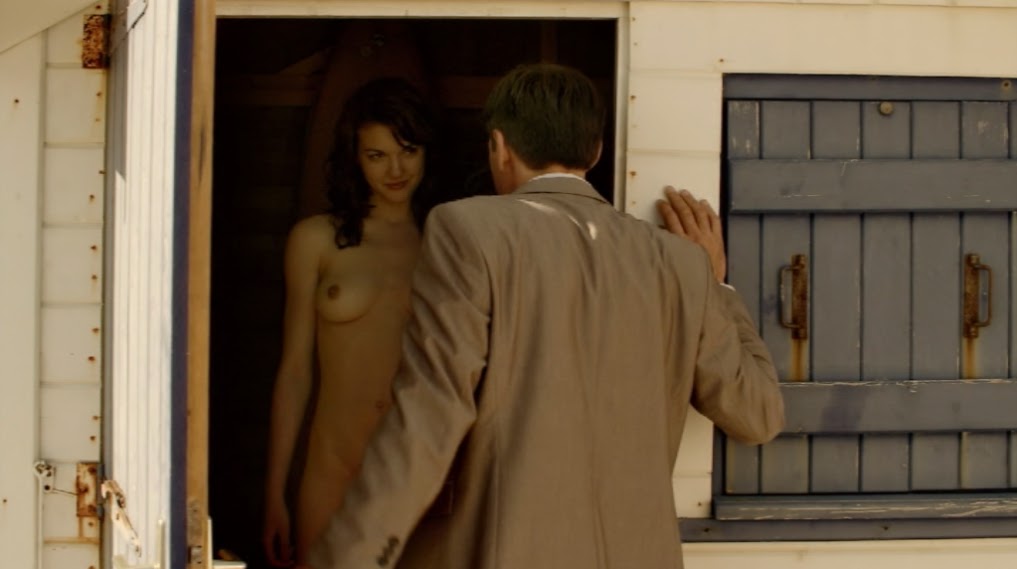
NSFW ‘Q’ image gallery after the jump.


Read More
Posted in Deborah Revy, Laurent Bouhnik, Winter of Discontent | No comments
Older Posts Home
Subscribe to: Posts (Atom)

Popular Posts

  • BLACK VALENTINES: Thirst
    Let’s try a scenario on for size: boy meets girl; obstacles prevent them from being together; boy and girl get together any way; a major o...
  • Boarding Gate
    The first film of Olivier Assayas’s I saw was ‘Irma Vep’, a dreamy fantasia on two highly different forms of cinema – the work of French dir...
  • 13 FOR HALLOWEEN #1: Tenebrae
    “When you have eliminated the impossible, what remains – however improbable – must be the truth.” This quote, from Conan Doyle’s ‘The Hound ...
  • 13 FOR HALLOWEEN #4: The Unborn
    As with ‘Giallo’ a couple of weeks ago, I approached this knowing that it had been roundly peed on by the critics, only to spend the first h...
  • BOND-A-THON: A View to a Kill
    Beware the temptation of the snap judgement. Particularly when undertaking a movie-thon whose entries you’re watching sequentially rather th...
  • A Lonely Place to Die
    Julian Gilbey was behind 2007’s ‘Rise of the Footsoldier’ – a film so mired in trite hooliganism clichés and dodgy Lahdan accents that it ma...
  • Strait Jacket
    Shinji Ushiro’s hectic anime ‘Strait Jacket’ takes a premise that requires a suspension of disbelief plus VAT, welds it to a hefty chunk o...
  • WINTER OF DISCONTENT: Death Laid an Egg
    Picture the scene: yours truly and his good lady wife enter a fish ‘n’ chip shop, emphatically debating yours truly’s recent film-viewing ch...
  • Brave
    Has the Pixar bubble burst? Two years ago, I came out of ‘Toy Story 3’ with mixed feelings – so mixed that I elected not to post a review on...
  • SUMMER OF SATAN: Alucarda
    Juan Lopez Monctezuma’s hallucinatory exploitationer is a heady and unsubtle mix of nunsploitation, sexual hysteria, Satanism, vampirism, py...

Categories

  • 13 for Halloween (29)
  • Abbie Cornish (1)
  • Abel Ferrara (1)
  • Adam Gierasch (1)
  • Adam Green (2)
  • Adolfo Celli (1)
  • Adrian Brody (1)
  • Adrien Brody (1)
  • Adrienne Barbeau (1)
  • Ahna Capri (1)
  • aimless drivel (1)
  • Akon (1)
  • Al Pacino (1)
  • Alain Cuny (1)
  • Alain Delon (3)
  • Alamanta Keller (1)
  • Alan Galton (1)
  • Alan Sillitoe (16)
  • Alan Tudyk (1)
  • Albert Pyun (1)
  • Alberto de Mendoza (1)
  • Aldo Lado (1)
  • Aldo Massasso (1)
  • Aldo Valetti (1)
  • Alec McCowan (1)
  • Alec Newman (1)
  • Alejandre Aja (1)
  • Alejandro Jodorowsky (1)
  • Alessio Orano (1)
  • Alex Angulo (1)
  • Alex de la Iglesia (1)
  • Alex Lowe (1)
  • Alex Proyas (1)
  • Alexa Jago (1)
  • Alexandra Negrao (1)
  • Alexandra Paul (1)
  • Alfred Hitchcock (1)
  • Alfredo Mayo (1)
  • Alice Braga (1)
  • Alida Valli (1)
  • Amanda Seyfried (1)
  • Amando de Ossorio (1)
  • Amber Heard (4)
  • Amelia Kinkade (4)
  • Amy Adams (2)
  • Andre Garet (1)
  • Andrea Bianchi (1)
  • Andrea Occhipinti (1)
  • Andrea Riseborough (1)
  • Andrew Weir (1)
  • Andrzej Zulawski (1)
  • Andy Devonshire (1)
  • Angelina Jolie (1)
  • Angharad Rees (1)
  • Ania Pieroni (1)
  • Anita Ekberg (2)
  • Anna Friel (1)
  • Anna Massey (2)
  • Anna Mouglalis (1)
  • Anna Proclemer (1)
  • Annalynne McCord (1)
  • AnnaSophia Robb (1)
  • Anne Heywood (1)
  • Anne Libert (1)
  • Annette Vadim (1)
  • Anthony Andrews (1)
  • Anthony Franciosa (1)
  • Anthony Hopkins (2)
  • Anthony Mann (1)
  • Anthony Steffen (1)
  • Anton Diffring (1)
  • Antonio Banderas (1)
  • Antonio Margheriti (2)
  • Anuska Borova (1)
  • Ariel Vromen (1)
  • Ariel Winter (1)
  • Armando De Razza (1)
  • Asami (1)
  • Asia Argento (3)
  • Audrey Hepburn (1)
  • Aurelian Wiik (1)
  • Austin Stoker (1)
  • Banksy (1)
  • Barbara Bach (1)
  • Barbara Bouchet (4)
  • Barbara Cupisti (1)
  • Barbara Hershey (1)
  • Barbara Leigh-Hunt (1)
  • Barbara Shelley (1)
  • Barbara Stanwyck (1)
  • Barry Foster (1)
  • Barry Pepper (1)
  • Barry Sonnenfeld (1)
  • Ben Gazzara (1)
  • Ben Kingsley (2)
  • Ben Mendelsohn (1)
  • Ben Wishaw (2)
  • Benedict Cumberpatch (2)
  • Benicio del Toro (2)
  • Berenice Marlohe (1)
  • Bernadette Peters (1)
  • Bernard Lee (6)
  • Bernard McEveety (1)
  • Bernd Eichinger (1)
  • Bette Midler (1)
  • Betty White (1)
  • Bill Hader (1)
  • Bill Paxton (2)
  • Billy Connolly (2)
  • Bitto Albertini (2)
  • Black valentines (9)
  • blog-a-thon (1)
  • Blythe Danner (1)
  • Blythe Metz (1)
  • Bo Svenson (2)
  • Bob Belling (1)
  • Bob Hoskins (1)
  • Bob Larsen (1)
  • Bond-a-thon (26)
  • Brad Anderson (1)
  • Brad Dourif (2)
  • Brad Pitt (1)
  • Bradley Cooper (1)
  • Brahim Haggiag (1)
  • Brandon Jay MacLaren (1)
  • Brenda Chapman (1)
  • Brian Cox (1)
  • Brian Langtry (1)
  • Brian Trenchard-Smith (1)
  • Brigitte Lahaie (2)
  • Britt Ekland (2)
  • Britt Nicholls (1)
  • Brooke Adams (1)
  • Bruce Greenwood (1)
  • Bruno Mattei (1)
  • Bryce Wilson (1)
  • Burt Lancaster (1)
  • Byung-ho Son (1)
  • Byung-hun Lee (1)
  • Caitlin Wachs (1)
  • Cam Gigandet (1)
  • Cameron Mitchell (1)
  • Carey Lowell (1)
  • Carice van Houten (1)
  • Carl Parker (1)
  • Carla Borelli (1)
  • Carla Brait (1)
  • Carla Gugino (1)
  • Carlo De Mejo (1)
  • Carlo Gentili (1)
  • Carlos Aured (1)
  • Carole Bouquet (1)
  • Caroline Bliss (1)
  • Caroline Munro (2)
  • Carrie Anne Fleming (1)
  • Carroll Baker (2)
  • Cate Blanchett (1)
  • Catherine Deneuve (1)
  • Cathy Podewell (1)
  • Cathy Tyson (1)
  • Catriona MacCall (1)
  • Cecile de France (2)
  • Chan-wook Park (2)
  • Chandler Canterbury (1)
  • Chantal Contouri (1)
  • Charles Bateman (1)
  • Charles Gray (2)
  • Charlie Creed-Mills (1)
  • Charlize Theron (2)
  • Charlotte Gainsbourg (1)
  • Cheech Marin (1)
  • Chiara Caselli (2)
  • Chloe Sevigny (1)
  • Chow Yun Fat (1)
  • Chris Butler (1)
  • Chris Evans (3)
  • Chris Hemsworth (1)
  • Chris Mitchum (1)
  • Chris Pine (1)
  • Chris Renaud (2)
  • Christian Bale (1)
  • Christina Lindberg (1)
  • Christina Ricci (1)
  • Christina von Blanc (2)
  • Christine Taylor (1)
  • Christoph Waltz (2)
  • Christopher George (1)
  • Christopher Jones (1)
  • Christopher Kirby (1)
  • Christopher Lee (4)
  • Christopher Mintz-Plasse (1)
  • Christopher Walken (2)
  • Clare Bloom (1)
  • Claudine Auger (1)
  • Claudio Brook (1)
  • Clifton James (2)
  • Clint Eastwood (1)
  • Clint Howard (1)
  • Coen Brothers (1)
  • Colin Firth (1)
  • Coralie Rose (1)
  • Coraline Trinh Thi (1)
  • Corbin Allred (1)
  • Corinne Cleary (2)
  • Craig Collicott (1)
  • Craig Fairbrass (1)
  • Craig Robinson (1)
  • Cristina Airoldi (1)
  • Cristine Galbo (1)
  • Curt Jurgens (1)
  • Cyril Cusack (1)
  • Dagmar Lassender (2)
  • Daniel Alfredson (2)
  • Daniel Barber (1)
  • Daniel Craig (4)
  • Daniela Bianchi (1)
  • Danielle Panabaker (1)
  • Danny Huston (1)
  • Danny Lee (1)
  • Danny McBride (1)
  • Danny Trejo (2)
  • Dante Maggio (1)
  • Dardenne Brothers (1)
  • Daria Nicolodi (1)
  • Dario Argento (6)
  • Darren Aronofsky (1)
  • Darren Moore (1)
  • Darwin Joston (1)
  • Dave Gorman (1)
  • David Bell (1)
  • David Carradine (1)
  • David Caruso (1)
  • David Duchovny (1)
  • David Fincher (1)
  • David Hemmings (1)
  • David Hess (1)
  • David Hyry (1)
  • David Lynch (1)
  • David Morrissey (1)
  • David Schwimmer (1)
  • David Soul (1)
  • David Warbeck (1)
  • Deborah Francois (1)
  • Deborah Revy (2)
  • Declan O'Brien (1)
  • Dee Wallace (1)
  • Delphine Chaneac (1)
  • Deneen Melody (2)
  • Denholm Elliott (1)
  • Denise Richards (1)
  • Dennis Dun (1)
  • Dennis Farina (1)
  • Dennis Waterman (1)
  • Denzel Washington (1)
  • Derek Cianfrance (1)
  • Derrick Buttress (1)
  • Desmond Llewellyn (4)
  • Diana Lorys (1)
  • Diana Rigg (1)
  • Diane Lane (3)
  • Dinah Sheridan (1)
  • Diora Baird (1)
  • Dirk Bogarde (1)
  • documentary (6)
  • Dom DeLuise (1)
  • Domenico Paollela (1)
  • Dominic West (1)
  • Don Cheadle (1)
  • Don DeLillo (1)
  • Don Edmonds (2)
  • Don Michael Paul (1)
  • Don Pedro Colley (1)
  • Donald Pleasance (3)
  • Donald Sutherland (1)
  • Doug Bradley (1)
  • Dustin Hoffman (1)
  • Dyanne Thorne (4)
  • E Emmet Walsh (1)
  • Ed Speelers (1)
  • Ed Stoppard (1)
  • Eddie Marsan (1)
  • Eddie Marsen (1)
  • Edgar Wright (2)
  • Edith Lemerdy (1)
  • Edward Furlong (1)
  • Edward Norton (1)
  • Edwige Fenech (4)
  • Eiji Funakoshi (1)
  • Eiko Matsuda (1)
  • Eileen Daly (2)
  • Eleanoria Rossi Drago (1)
  • Eleonora Brown (1)
  • Eli Craig (1)
  • Eli Wallach (2)
  • Elizabeth Banks (1)
  • Elizabeth Taylor (3)
  • Ellen Ewusie (1)
  • Eloy de la Iglesia (1)
  • Elsa Lanchester (1)
  • Elsa Martinelli (1)
  • Elsa Pataky (1)
  • Ely Galleani (4)
  • Emilie di Ravin (1)
  • Emilio Miraglia (2)
  • Emily Blunt (5)
  • Emily Browning (2)
  • Emily Mortimer (4)
  • Emily Perkins (2)
  • Emily Watson (1)
  • Emma Bell (1)
  • Emma Thompson (1)
  • Emma Watson (2)
  • Emmanuelle Beart (1)
  • Emmanuelle Seigner (1)
  • Emmanuelle Vaugier (1)
  • Enrico Maria Salerno (1)
  • ensemble pieces (1)
  • Enzo G Castellari (2)
  • Eri Otoguro (1)
  • Eric Roberts (1)
  • Eric Weston (1)
  • Ernest Borgnine (2)
  • Estelle Lebefure (1)
  • Ethan Manquis (1)
  • Eva Bartok (1)
  • Eva Green (1)
  • Eva Leon (1)
  • Eva Mendes (1)
  • Evan Rachel Wood (1)
  • Ewa Aulin (1)
  • Ewan McGregor (2)
  • F Gary Gray (1)
  • Fabienne Dali (1)
  • Fabiola Toledo (1)
  • Fabrice du Welz (5)
  • Famke Janssen (2)
  • Femi Benussi (4)
  • Ferdinando Merighi (1)
  • Fernando Meirelles (1)
  • Fernando Rey (1)
  • Fernando Sancho (1)
  • fiction (1)
  • Flavio Bucci (1)
  • Florian Henckel von Donnersmarck (2)
  • Florinda Bolkan (1)
  • Frances Barber (1)
  • Franck Khalfoun (1)
  • Franco Fantasia (1)
  • Franco Nero (2)
  • Francois Perier (2)
  • Frank Grillo (1)
  • Frank Pierson (1)
  • Frank Wolff (2)
  • Fred Williamson (1)
  • Frieda Pinto (1)
  • Gabriele Ferzetti (1)
  • Gabriella Hall (1)
  • Gadi Harel (1)
  • Gary Oldman (3)
  • Gemma Arterton (2)
  • Geoffrey Palmer (1)
  • George Baker (1)
  • George Clooney (2)
  • George Hilton (3)
  • George Lazenby (1)
  • George Martin (1)
  • George Riddle (1)
  • George Rigaud (1)
  • Georges Corraface (1)
  • Georgia Groome (1)
  • Gerard Butler (1)
  • Gerard Depardieu (1)
  • Gert Frobe (1)
  • giallo (32)
  • Gian Maria Volonte (1)
  • Giancarlo Giannini (1)
  • Gianfranco Di Grassi (1)
  • Gianni Garko (1)
  • Gillian Anderson (1)
  • Gillian Hills (1)
  • Gillo Pontecorvo (1)
  • Gina Carano (1)
  • Gina Lollobrigida (1)
  • Giovanna Ralli (1)
  • Giovanni Lombardo Radice (1)
  • Giovanni Ribisi (1)
  • Girgio Cataldi (1)
  • Gotz Otto (2)
  • Grace Jones (1)
  • Grace Zabriski (1)
  • Graham Greene (1)
  • Grant Harvey (1)
  • Grant Heslov (1)
  • Greg Mottola (1)
  • Greta Gerwig (1)
  • Gunnar Hansen (1)
  • Guy Hamilton (3)
  • Guy Ritchie (2)
  • Ha-kyun Shin (1)
  • Hailee Steinfeld (1)
  • Hal Holbrook (1)
  • Halle Berry (1)
  • Harry Dean Stanton (1)
  • Harry H Corbett (1)
  • Harvey Korman (1)
  • Hayden Christensen (1)
  • Hayley Atwell (1)
  • Heath Ledger (1)
  • Heather Graham (1)
  • Heinz Bennent (1)
  • Helen McCrory (1)
  • Helen Mirren (1)
  • Helena Bonham Carter (1)
  • Helga Line (1)
  • Henry Silva (1)
  • Herbert Lom (1)
  • Herve Villchaize (1)
  • Hikari Mitsushima (1)
  • Hilary Swank (1)
  • Hiram Keller (1)
  • Hodder Kane (1)
  • Honor Blackman (2)
  • horror (1)
  • Horst Janson (1)
  • Howard Ross (1)
  • Howard Vernon (2)
  • Hugh Quarshie (1)
  • Hugo Weaving (1)
  • Humphrey Bogart (1)
  • Ian Bannen (2)
  • Ian Hendry (1)
  • Ida Galli (1)
  • Ida Lupino (2)
  • Idris Elba (2)
  • Ilisa Barbash (1)
  • Imelda Staunton (1)
  • Imogen Poots (1)
  • Ines Pellegrini (1)
  • Ingrid Pitt (1)
  • Irene Jacob (1)
  • Irene Miracle (1)
  • Iron Maiden (1)
  • Isabelle Adjani (1)
  • Isabelle Corey (1)
  • Isla Fisher (2)
  • Ivan Rassimov (4)
  • Izabella Scorupco (1)
  • J Blakeson (1)
  • J J Abrams (1)
  • Jack Hedley (2)
  • Jack Hill (1)
  • Jack Kehoe (1)
  • Jack Lord (1)
  • Jack Starrett (1)
  • Jackie Berroyer (2)
  • Jacky Cheung (1)
  • Jacob Latimore (1)
  • Jake West (1)
  • James Bolam (1)
  • James D R Hickox (1)
  • James Donald (1)
  • James Ellroy (1)
  • James Franco (2)
  • James Herbert (1)
  • James McAvoy (1)
  • James McTeigue (1)
  • Jameson Parker (1)
  • Jamie Chung (1)
  • Jamie Foxx (1)
  • Jamie Lee Curtis (3)
  • Jan Sisk (1)
  • Jane Alexander (1)
  • Jane Birkin (1)
  • Jane Bruton (1)
  • Jane Lynch (1)
  • Jane Ryall (1)
  • Jane Seymour (1)
  • Janet Agren (2)
  • Janet Greek (1)
  • Janet Julian (1)
  • January Jones (1)
  • Jared Harris (1)
  • Jason Bateman (1)
  • Jason Statham (2)
  • Jason Williamson (1)
  • Javier Bardem (1)
  • Jay Baruchel (1)
  • Jean Lafleur (1)
  • Jean Martin (1)
  • Jean Rollin (2)
  • Jean Sorel (2)
  • Jean-Francois Richet (2)
  • Jean-Louis Trintignant (1)
  • Jean-Luc Couchard (1)
  • Jean-Marc Barr (1)
  • Jean-Paul Belmondo (1)
  • Jean-Pierre Jarris (1)
  • Jean-Pierre Melville (5)
  • Jeff Bridges (2)
  • Jeffrey Wright (2)
  • Jemaine Clement (1)
  • Jena Malone (1)
  • Jennifer Connelly (1)
  • Jennifer Lawrence (2)
  • Jennifer Rhodes (1)
  • Jennifer Tilly (2)
  • Jennifer Westfeldt (1)
  • Jenny Spain (1)
  • Jeremiah Kipp (2)
  • Jeroen Krabbe (1)
  • Jess Franco (2)
  • Jesse Eisenberg (1)
  • Jessica Alba (1)
  • Jessica Chastain (1)
  • Jessica Harper (1)
  • Jessica Pare (1)
  • Jesus Puente (1)
  • Ji-eun Lim (1)
  • Jill St John (1)
  • Jim Jarmusch (1)
  • Jimmy Kaufman (1)
  • Jimmy McNichol (1)
  • Jo Van Fleet (1)
  • Joan Leslie (1)
  • Joanne Nail (1)
  • Jocelin Donahue (1)
  • Jodie Whittaker (1)
  • Joe Augustyn (2)
  • Joe Carnahan (1)
  • Joe Cornish (1)
  • Joe D'Amato (4)
  • Joe Dallesandro (1)
  • Joe Dante (1)
  • Joe Don Baker (2)
  • Joe Johnston (1)
  • Joe Wiezycki (1)
  • Joel Schumacher (1)
  • Joelle Coeur (3)
  • Joely Richardson (1)
  • Johanna Hofer (1)
  • John Boyega (1)
  • John Brumpton (1)
  • John C Reilly (1)
  • John Carpenter (10)
  • John Carradine (1)
  • John Carson (1)
  • John Cleese (1)
  • John Gielgud (1)
  • John Glen (5)
  • John Goodman (1)
  • John Halas (1)
  • John Hurt (1)
  • John Landis (1)
  • John Lasseter (1)
  • John Leguizamo (1)
  • John Lithgow (1)
  • John Malkovich (1)
  • John McQuade (1)
  • John Osborne (1)
  • John Rhys-Davies (1)
  • John Richardson (1)
  • John Rico (1)
  • John Ritter (1)
  • John Saxon (2)
  • John Sayles (1)
  • John Stockwell (1)
  • John Sturges (1)
  • John Thaw (1)
  • John Vernon (1)
  • John Woo (2)
  • Johnny Depp (3)
  • Jon Finch (1)
  • Jon Tenney (1)
  • Jonah Hill (1)
  • Jonathan Frid (1)
  • Jonathan McDaniel (1)
  • Joseph Kosinski (1)
  • Joseph Wiseman (1)
  • Josh Brolin (2)
  • Josie Ho (1)
  • Joss Whedon (2)
  • Joy Batchelor (1)
  • Juan Lopez Monctezuma (1)
  • Jude Law (1)
  • Judi Dench (6)
  • Julia Dietze (1)
  • Julia Duffy (1)
  • Julian Gilbey (2)
  • Julian Glover (2)
  • Julie Walters (1)
  • Kang-ho Song (1)
  • Karen Bach (1)
  • Kari Wuhrer (1)
  • Karin Schubert (2)
  • Karina Testa (1)
  • Kate Ashfield (1)
  • Kate Beckinsale (1)
  • Kate Magowan (1)
  • Katee Sackhoff (1)
  • Katharine Isabelle (4)
  • Katherine Heigl (1)
  • Katherine MacColl (1)
  • Kathleen Archer (1)
  • Kathleen Quinlan (1)
  • Kathryn Bigelow (2)
  • Kathy Najimy (1)
  • Katia Christine (1)
  • Katrina Bowden (1)
  • Katya Wyeth (1)
  • Keith Gordon (1)
  • Kelly Macdonald (1)
  • Kelly McGillis (1)
  • Kelly Preston (2)
  • Kelly Reilly (1)
  • Ken Adam (1)
  • Ken Russell (1)
  • Ken Wiederhorn (1)
  • Kerim Bursin (1)
  • Kerry Washington (1)
  • Kevin Bacon (1)
  • Kevin Costner (1)
  • Kevin Pollak (1)
  • Kevin Smith (1)
  • Kevin Spacey (1)
  • Kevin Tenney (2)
  • Kevin Zegers (1)
  • Kim Cattrall (1)
  • Kim Jee-Woon (1)
  • Kim Rossi Stuart (1)
  • Kirby Heyborne (1)
  • Kirk Douglas (2)
  • Kodi Smit-McPhee (1)
  • Kristanna Loken (1)
  • Kristen Wiig (3)
  • Kurt Russell (1)
  • L.Q. Jones (1)
  • Lamberto Bava (1)
  • Lance Henriksen (1)
  • Lara Naszinsky (1)
  • Lara Parker (1)
  • Lara Robinson (1)
  • Lars von Trier (2)
  • Laura Belli (1)
  • Laura Betti (1)
  • Laura D'Angelo (1)
  • Laura Fraser (1)
  • Laura Gemser (6)
  • Laura Mennell (1)
  • Laura-Leigh (1)
  • Lauren Graham (1)
  • Laurence Fishburne (2)
  • Laurent Bouhnik (1)
  • Laurent Lucas (1)
  • Laurie Zimmer (1)
  • Lawrence Dane (1)
  • Lea Michele (1)
  • Lea Pool (1)
  • Len Holden (1)
  • Lena Headey (1)
  • Leonardo diCaprio (2)
  • Leonor Watling (2)
  • Lesley-Anne Down (1)
  • Lewis Fiander (1)
  • Lewis Gilbert (4)
  • Liam Neeson (2)
  • Lieva Lone (1)
  • Liliana Cavani (1)
  • Lina Romay (2)
  • Linda Blair (1)
  • Linda Hayden (2)
  • Lindsay Anderson (1)
  • Lindsay Lohan (3)
  • Linnea Quigley (2)
  • Lisa Blount (1)
  • Lisa Howard (1)
  • Liv Boughn (1)
  • Lois Chiles (1)
  • Loretta Swit (1)
  • Lotte Lenya (1)
  • Lou Doillon (1)
  • Louis Jourdan (1)
  • Louis Letterier (1)
  • Luciana Paluzzi (1)
  • Luciano Ercoli (1)
  • Lucien Castaing-Taylor (1)
  • Lucio Fulci (4)
  • Ludivine Sagnier (2)
  • Luigi Bazzoni (1)
  • Luigi Caselleto (1)
  • Luigi Cozzi (1)
  • Lyndsy Fonseca (1)
  • Macha Meril (1)
  • Madeleine Kahn (1)
  • Madeline Smith (1)
  • Mads Mikkelsen (1)
  • Maggie Grace (1)
  • Mai Takahashi (1)
  • Maitland McConnell (1)
  • Mako Midori (1)
  • Malcolm McDowell (1)
  • Malcom Pinnegar (1)
  • Mamie Gummer (1)
  • Manuel Carballo (1)
  • Mapi Galan (1)
  • Marc Forster (1)
  • Marcel Sarmiento (1)
  • Marcus Carl Franklin (1)
  • Marcus Markou (1)
  • Maria de Medeiros (1)
  • Maria Mancini (1)
  • Maria Perschy (1)
  • Maria Pia Conte (1)
  • Maria Pia Giancaro (1)
  • Marilyn Burns (1)
  • Marilyn Roberts (1)
  • Marina Coffa (1)
  • Marina Malfatti (1)
  • Mario Bava (2)
  • Mario Bianchi (1)
  • Marisa Bartoli (1)
  • Mark Addy (1)
  • Mark Andrews (1)
  • Mark Damon (1)
  • Mark Feuerstein (1)
  • Mark Joffe (1)
  • Mark Kermode (1)
  • Mark Ruffalo (3)
  • Mark Strong (2)
  • Mark Wahlberg (1)
  • Marki Bey (1)
  • Marley Shelton (1)
  • Martin Campbell (2)
  • Martin Compston (1)
  • Martin Freeman (1)
  • Martin Ritt (1)
  • Martin Scorsese (1)
  • Martina Berti (1)
  • Martina Gedeck (1)
  • Martine Beswick (1)
  • Martine Brochard (2)
  • Marty Feldman (1)
  • Mary Woronov (2)
  • Maryam d'Abo (1)
  • Masumi Miyazaki (1)
  • Mathieu Amalric (1)
  • Mathilda May (1)
  • Matt Damon (1)
  • Maud Adams (2)
  • Maud Forget (1)
  • Maurizio Lucidi (1)
  • Max Phipps (1)
  • Max von Sydow (2)
  • Me Me Lai (1)
  • Meagan Good (1)
  • Meat Loaf (1)
  • Mel Brooks (2)
  • Mel Ferrer (1)
  • Melanie Laurent (1)
  • Melissa George (3)
  • Melissa Leo (1)
  • Michael Apted (1)
  • Michael Caine (6)
  • Michael Douglas (1)
  • Michael Eaton (1)
  • Michael Fassbender (1)
  • Michael Madsen (2)
  • Michael Nyqvist (3)
  • Michael Parks (1)
  • Michael Radford (1)
  • Michael Reeves (1)
  • Michael Rennie (1)
  • Michael Shannon (2)
  • Michael Sheen (1)
  • Michael Wincot (1)
  • Michael Winterbottom (1)
  • Michael York (1)
  • Michel Antoine (1)
  • Michel Lemoine (1)
  • Michel Lonsdale (1)
  • Michel Piccoli (1)
  • Michele Placido (1)
  • Michele Soavi (2)
  • Michelle Forbes (1)
  • Michelle Rodriguez (1)
  • Michelle Williams (1)
  • Michelle Yeoh (1)
  • Mick Richmond (1)
  • Mickey Rooney (1)
  • Miguel Ferrer (1)
  • Mike Hodges (1)
  • Mike Nichols (1)
  • Mike Reid (1)
  • Miki Mizuno (2)
  • Mila Kunis (3)
  • Min-sik Choi (2)
  • Minase Yashiro (1)
  • Minnie Driver (1)
  • Mireille Dargent (1)
  • Mischa Barton (1)
  • Monica Gayle (1)
  • Monica Keena (1)
  • Morgan Freeman (2)
  • Myleene Demongeot (1)
  • Nagisa Oshima (1)
  • Nao Nagasawa (1)
  • Narciso Ibanez Serrador (1)
  • Nastassja Kinski (1)
  • Natalie Portman (1)
  • Nathan Fillion (1)
  • Nathaniel Arcand (1)
  • Ned Beatty (1)
  • Neil Jordan (1)
  • Nick Frost (4)
  • Nick Jolley (1)
  • Nick Murphy (1)
  • Nick Park (1)
  • Nick Stabile (1)
  • Nico Mastorakis (1)
  • Nicolas Cage (2)
  • Nicoletta Elmi (1)
  • Niels Arden Oplev (1)
  • Nigel Kneale (1)
  • Nike Arrighi (1)
  • Nino Castelnuovo (1)
  • Noah Segan (1)
  • Noboru Iguchi (1)
  • Noomi Rapace (3)
  • Noriku Sengoku (1)
  • Norman Reedus (1)
  • Nottingham Contemporary (2)
  • Odette Yustman (1)
  • Ok-bin Kim (1)
  • Olga Kurylenko (2)
  • Oliver Megatron (1)
  • Oliver Stone (1)
  • Olivier Assayas (1)
  • Ornella Muti (2)
  • Oskar Werner (1)
  • Paddy Considine (1)
  • Pam Grier (2)
  • Paola Senatore (1)
  • Paolo Bonacelli (1)
  • Paolo Morra (1)
  • Pascal Laugier (1)
  • Pasquale Festa Campanile (1)
  • Pat Healy (1)
  • Patricia Clarkson (1)
  • Patricia Hermenier (1)
  • Patricia Rodriguez (1)
  • Patrick Lussier (2)
  • Patrick Macnee (1)
  • Patrick Magee (1)
  • Patrick Mower (1)
  • Patrick Stewart (2)
  • Paul A Partain (1)
  • Paul Bettany (1)
  • Paul Eddington (1)
  • Paul Giametti (1)
  • Paul Jones (1)
  • Paul Maslansky (1)
  • Paul Naschy (1)
  • Paul Newman (2)
  • Paul W S Anderson (1)
  • Penelope Buitenhuis (1)
  • personal faves (5)
  • Peta Sergeant (1)
  • Petch Osathanugrah (1)
  • Pete Postlethwaite (1)
  • Peter Collinson (2)
  • Peter Cushing (2)
  • Peter Fonda (1)
  • Peter Holden (1)
  • Peter Hunt (1)
  • Peter Sykes (1)
  • Petra Markham (1)
  • Philip Seymour Hoffman (1)
  • Pia Degermark (1)
  • Pier Angeli (1)
  • Pier Paolo Capponi (1)
  • Pier Paolo Pasolini (1)
  • Pierce Brosnan (4)
  • Pierfrancesco Favino (1)
  • Pierre Clementi (1)
  • Pierre Coffin (2)
  • Pierre Morel (1)
  • Piper Perabo (1)
  • Pixar (2)
  • Pratibha Parmar (1)
  • Preston Jones (1)
  • Prunella Ransome (1)
  • Quentin Tarantino (2)
  • R.G. Armstrong (2)
  • Rachel Nichols (3)
  • Rachel Weisz (2)
  • Rachelle Lefevre (1)
  • Radley Metzger (1)
  • Raf Baldassarre (1)
  • Raffaella Anderson (1)
  • Ralph Fiennes (2)
  • Ralph Richardson (1)
  • Raoul Walsh (1)
  • Ray Liotta (1)
  • Ray Lovelock (1)
  • Ray Simpson (1)
  • Ray Winstone (1)
  • Rebecca Brooke (1)
  • Rebecca Hall (1)
  • Rebekah Ellis (1)
  • Regis Roinsard (1)
  • Rena Niehaus (1)
  • Renato Cestie (1)
  • Rene Lefevre (1)
  • Rhonda Fleming (1)
  • Ricci Harnett (1)
  • Richard Bates Jnr (1)
  • Richard Burton (1)
  • Richard Crenna (1)
  • Richard Franklin (1)
  • Richard Gere (1)
  • Richard Harris (1)
  • Richard J Lewis (1)
  • Richard Kiel (1)
  • Richard Moll (1)
  • Richard Widmark (1)
  • Rick Yune (1)
  • Rie Ino'o (1)
  • Rie Kunawa (1)
  • Rita Tushingham (1)
  • Robb Leigh Davis (1)
  • Robbie Coltrane (1)
  • Robbie Lee (1)
  • Robert Altman (1)
  • Robert Brown (3)
  • Robert Carlyle (1)
  • Robert Davi (2)
  • Robert de Niro (1)
  • Robert Downey Jnr (2)
  • Robert Englund (1)
  • Robert Fuest (1)
  • Robert Hardy (1)
  • Robert Hoffmann (2)
  • Robert Hossein (1)
  • Robert Kerman (1)
  • Robert Mitchum (1)
  • Robert Morris (1)
  • Robert Prosky (1)
  • Robert Quarry (1)
  • Robert Rodriguez (1)
  • Robert Shaw (1)
  • Robert Zemeckis (1)
  • Robin McLeavy (2)
  • Rod Hardy (1)
  • Rod Mullinar (1)
  • Rod Serling (1)
  • Roddy McDowall (1)
  • Roger Corman (1)
  • Roger Duchesne (1)
  • Roger Moore (7)
  • Roger Spottiswoode (1)
  • Rolfe Kanefsky (1)
  • Romain Duris (1)
  • Romina Mondello (1)
  • Ron Carey (1)
  • Ron Perlman (1)
  • Ronnie Yu (1)
  • Ronny Jhutti (1)
  • Rosalba Neri (2)
  • Rosamund Pike (2)
  • Rose Byrne (2)
  • Rose McGowan (1)
  • Roy Dupuis (1)
  • Roy Ward Baker (1)
  • Rufus Sewell (1)
  • Ruggero Deodato (1)
  • Rupert Davies (1)
  • Rupert Wyatt (1)
  • Russell Brand (2)
  • Russell Crowe (1)
  • Rutger Hauer (1)
  • Ryan Gosling (1)
  • Ryan Little (1)
  • Saadi Yacef (1)
  • Sakura Ando (1)
  • Sally Smith (1)
  • Sally Yeh (1)
  • Sam Derby-Cooper (1)
  • Sam Dunn (1)
  • Sam Fell (1)
  • Sam Mendes (3)
  • Sam Neill (2)
  • Sam Peckinpah (2)
  • Sam Raimi (1)
  • Samantha Bond (1)
  • Samuel L Jackson (2)
  • Santiago Segura (1)
  • Sara Malakul Lane (1)
  • Sara Paxton (1)
  • Sarah Jessica Parker (1)
  • Sarah Polley (2)
  • Sarah Silverman (1)
  • satire (1)
  • Scarlett Johannson (1)
  • Scot McFadyen (1)
  • Scott Speedman (1)
  • Sean Byrne (1)
  • Sean Connery (8)
  • Sean Harris (1)
  • Selina Cadell (1)
  • Serena Grandi (1)
  • Serge Gainsbourg (1)
  • Serge Reggiani (1)
  • Sergio Bergonzelli (1)
  • Sergio Martino (2)
  • Sergio Stivaletti (1)
  • Seth McFarlane (1)
  • Seth Rogen (2)
  • Shane Black (1)
  • Shane Briant (10)
  • Shannon Elizabeth (1)
  • Shaun Benson (1)
  • Shawn Ashmore (1)
  • Shelley Conn (1)
  • Sherilyn Fenn (1)
  • Shiloh Fernandez (1)
  • Shinji Ushiro (1)
  • Shion Sono (1)
  • Shirley Cameron (1)
  • Shirley Eaton (1)
  • Sho Aikawa (1)
  • Shots on the Blog (28)
  • Sid Caesar (1)
  • Sidney Lumet (3)
  • Sigourney Weaver (1)
  • Silvia Tortosa (1)
  • Simon Andreu (2)
  • Simon Pegg (3)
  • Sleaford Mods (1)
  • small screen (1)
  • Sofia Coppola (1)
  • something for the weekend (13)
  • Son of Danse Macabre (1)
  • Sono Sion (1)
  • Sophie Marceau (1)
  • Sophie Vavasseur (1)
  • Stacy Keach (1)
  • Stanley Kubrick (1)
  • Stanley Tucci (1)
  • Stefano Accorsi (1)
  • Stefano Dionisi (1)
  • Stella Stevens (1)
  • Steph Wagstaffe (1)
  • Stephanie Bauer (1)
  • Stephanie Paul (1)
  • Stephen Billington (1)
  • Stephen Dillane (1)
  • Stephen Forsyth (1)
  • Stephen Hopkins (1)
  • Stephen King (1)
  • Stephen White (1)
  • Steve Buscemi (1)
  • Steve Carell (2)
  • Steve Coogan (2)
  • Steve Railsback (1)
  • Steven Berkoff (2)
  • Steven H Stern (1)
  • Steven Seagal (1)
  • Steven Soderbergh (1)
  • Steven Weber (1)
  • Strother Martin (1)
  • Su-chang Kong (1)
  • Sue Lyon (1)
  • Summer of Satan (18)
  • Susan Denberg (1)
  • Susan George (1)
  • Susan Scott (2)
  • Susan Tyrrell (1)
  • Susanna Kamina (1)
  • Suzy Kendall (2)
  • Sven-Bertil Taube (1)
  • Sybil Danning (1)
  • Sylvia Kristel (1)
  • Takahiro Nishijima (1)
  • Takanori Tsujimoto (2)
  • Takashi Miike (1)
  • Takumi Saito (1)
  • Talisa Soto (1)
  • Tamsin Egerton (1)
  • Tanya Roberts (1)
  • Tara Stone (1)
  • Tatiani Maslany (1)
  • Tatsuya Fuji (1)
  • Ted Post (1)
  • Telly Savalas (1)
  • Terence Fisher (2)
  • Terence Young (3)
  • Teri Hatcher (1)
  • Terry Gilliam (1)
  • Terry Stone (1)
  • Thandie Newton (2)
  • The Lonely Island (1)
  • Thea Gill (1)
  • Thierry Guetta (1)
  • Thomas Arana (1)
  • Thomas Doret (1)
  • Thomas L Dyke (1)
  • Thomas Reiner (1)
  • Thora Birch (1)
  • Thorley Walters (1)
  • Ti West (2)
  • Tim Burton (1)
  • Tim Daly (1)
  • Timo Vuorensola (1)
  • Timothy Dalton (3)
  • Tina Aumont (2)
  • Tina Romero (1)
  • Tisa Farrow (1)
  • Tobe Hooper (2)
  • Toby Stephens (1)
  • Todd Haynes (1)
  • Tom Cruise (1)
  • Tom Hanks (2)
  • Tom Hardy (2)
  • Tom Noonan (1)
  • Tom Savini (1)
  • Tom Skerritt (1)
  • Tom Wilkinson (1)
  • Tomas Alfredson (1)
  • Tomas Milian (2)
  • Tommy Lee Jones (2)
  • Toni Collette (1)
  • Tonino Valerii (1)
  • Tony Kendall (1)
  • Tony Leung (1)
  • Tony Scott (1)
  • Tony Todd (1)
  • Topol (1)
  • Traci Lords (1)
  • Trevor Howard (1)
  • Tyler Labine (1)
  • Udo Kier (3)
  • Ugo Liberatore (1)
  • Uli Edel (1)
  • Ulla Jacobson (1)
  • Umberto Lenzi (6)
  • Umberto Quintaville (1)
  • Ursula Andress (1)
  • Uschi Digard (1)
  • Uwe Boll (1)
  • Valeria Cavalli (1)
  • Valerie Leon (2)
  • Vanessa Hudgens (1)
  • Veronica Laria (1)
  • Veronica Miriel (1)
  • Victor Wong (2)
  • Victoria Maurette (1)
  • video nasty (1)
  • Vincent Cassel (3)
  • Vincent Schiavelli (1)
  • Vincenzo Natali (1)
  • Vinnie Jones (1)
  • Virginia Despentes (1)
  • Virginie Darmon (1)
  • Virginie Ledoyen (2)
  • Vittorio Storaro (1)
  • Viva la revolution (3)
  • Vivien Merchant (1)
  • Vlasta Vrana (1)
  • Waise Lee (1)
  • Walter Gotell (1)
  • Warren Oates (2)
  • Werner Herzog (3)
  • Wes Bentley (1)
  • Wilfrid Brambell (1)
  • Will Smith (1)
  • Will Yun Lee (1)
  • Willem Dafoe (2)
  • William Berger (1)
  • William Dear (1)
  • William Fichtner (1)
  • William Girdler (1)
  • William Ivory (1)
  • William Shatner (1)
  • Winona Ryder (1)
  • Winter of Discontent (65)
  • Woo-seong Kim (1)
  • Woody Harrelson (1)
  • Xavier Gens (1)
  • Xavier Samuel (1)
  • Yaphet Kotto (1)
  • Yasuzo Masamura (1)
  • Yeong-ae Lee (1)
  • Yorgos Lanthimos (1)
  • Yukie Kawamura (1)
  • Yves Montand (1)
  • Zachary Quinto (1)
  • Zack Snyder (1)
  • Zoe Daelman Chlanda (2)
  • Zoe Trilling (1)

Blog Archive

  • ▼  2013 (39)
    • ▼  July (8)
      • The World's End
      • Despicable Me 2
      • Despicable Me
      • THE AGITATION OF THE SMALL SCREEN: Steptoe and Son...
      • In brief: The Bling Ring
      • My Son, My Son, What Have Ye Done?
      • This is the End
      • What passes for normal service will resume shortly
    • ►  June (6)
    • ►  May (6)
    • ►  April (5)
    • ►  March (8)
    • ►  February (5)
    • ►  January (1)
  • ►  2012 (179)
    • ►  December (20)
    • ►  November (16)
    • ►  October (25)
    • ►  September (13)
    • ►  August (17)
    • ►  July (13)
    • ►  June (18)
    • ►  May (12)
    • ►  April (11)
    • ►  March (13)
    • ►  February (9)
    • ►  January (12)
  • ►  2011 (247)
    • ►  December (18)
    • ►  November (14)
    • ►  October (22)
    • ►  September (21)
    • ►  August (20)
    • ►  July (19)
    • ►  June (16)
    • ►  May (16)
    • ►  April (19)
    • ►  March (22)
    • ►  February (30)
    • ►  January (30)
  • ►  2010 (35)
    • ►  December (32)
    • ►  November (3)
Powered by Blogger.

About Me

Unknown
View my complete profile